

The 2024 Nobel Lauretes Gary Ruvkun and Victor Ambros receiving an award in 2014. Adam Fagen, CC BY 2.0, via Wikimedia Commons
The 2024 Nobel Prize in Physiology or Medicine was awarded to Victor Ambros and Gary Ruvkun for the discovery of microRNA, a small non-coding RNA molecule that plays a crucial role in the regulation of gene expression. This research was conducted using C. elegans as a model organism, making this the fourth Nobel Prize won utilizing C. elegans.
Victor Ambros is a Principal Investigator and Professor at UMass Chan Medical School. He continues to use C. elegans as a model organism to study the molecular mechanisms that regulate animal development. Gary Ruvkun is a Professor of Genetics at Harvard and Principal Investigator at Massachusetts General Hospital conducting research in microRNA, RNA interference, longevity, and detection of life on Mars.
Ambros and Ruvkun began studying genes that control the timing and activation of animal development as postdoctoral fellows in the Horvitz laboratory. They identified two genes, lin-4 and lin-14, that when mutated, disrupt proper development in C. elegans. Ambros discovered that in normal C. elegans development, lin-4 blocks the expression of the lin-14 gene, but the direct cause remained unknown.
After establishing laboratories of their own, Ambros made the surprising discovery that lin-4 did not encode a protein as most genes do, but rather a short strand of RNA we now know as microRNA. During this time, Ruvkun worked to unravel the mystery of how lin-4 inhibits the lin-14 gene from producing protein. It seemed that something prevented mRNA translation, the process that converts genes into proteins.
The researchers collaborated again and found that the two gene products – lin-4 microRNA and lin-14 mRNA – contain complementary RNA sequences. They showed that the microRNA can bind to mRNA and prevent protein production. This finding demonstrated that microRNA plays a role in controlling the development of C. elegans.
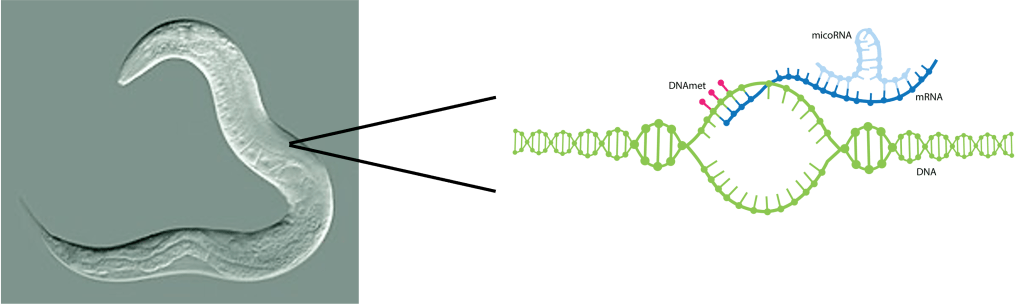
MicroRNA, a short strand of RNA that can inhibit mRNA translation, was discovered using C. elegans as a model organism.
Initially, it was thought that the microRNA phenomenon was unique to C. elegans. However, the Ruvkun lab’s discovery of a second microRNA gene in C. elegans expanded our understanding of the importance and prevalence of microRNAs across the animal kingdom. The Ruvkun lab found that unlike lin-4, this microRNA gene is shared by many animals, including humans. Since then, thousands of microRNAs have been identified and their importance in normal cell and tissue development has been elucidated.
MicroRNAs are important to human health and abnormalities in microRNA expression and regulation have been linked to many human diseases. As this year’s Nobel laureates have demonstrated, scientific discoveries made using C. elegans as model organisms can have profound impacts on not only the wealth of scientific knowledge, but also our understanding of human health.
.


