On April 10, 2025, the FDA announced a major policy shift: creating a roadmap outlining a strategic approach to reduce animal testing in preclinical safety studies. This transition prioritizes New Approach Methodologies (NAMs), including in silico modeling, in vitro human-based systems, and other innovative platforms, to improve the predictive relevance of preclinical drug safety testing and reduce reliance on animal models. But as we enter this new era, one lesser-known yet powerful model organism deserves the spotlight—Caenorhabditis elegans.
C. elegans, a tiny transparent nematode, has long been used in biomedical research for its simplicity, genetic tractability, and surprising biological relevance to humans. With the FDA now encouraging alternative models, C. elegans amenable to high-throughput screening providing human-relevant information is more relevant than ever. Here’s why:
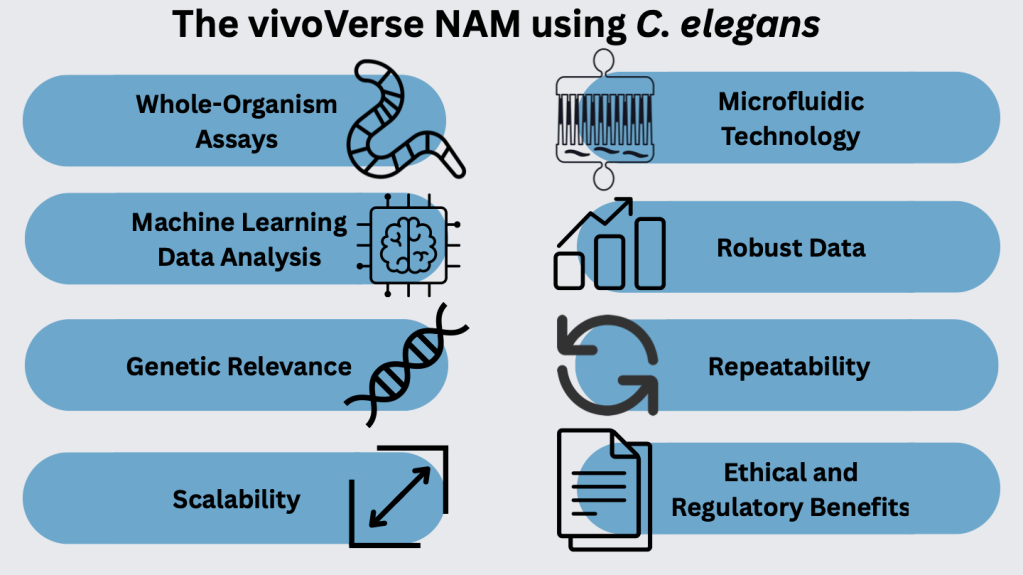
- Genetic relevance: Despite being only 1 mm long, C. elegans shares a significant number of genes, multi-organ systems, and conserved molecular pathways with humans, including those involved in neurodegeneration, xenobiotic, immunity, and cell signaling. This makes it an ideal in vivo system to study drug effects at a whole-organism level.
- Repeatability: vivoVerse’s vivoChip technology enables rapid, high content phenotypic readouts for toxicity, neurodegeneration, metabolism, and aging. Able to screen 24 unique populations with 40 animals per well and provide AI-assisted analysis with high-statistical power.
- Scalability: C. elegans can be grown in large numbers and screened in multi-well formats, allowing researchers to test large compound libraries quickly. Compared to traditional large animal models, it offers the assay outcomes in a fraction of the time and cost.
- Ethical and regulatory benefits: As the FDA promotes New Approach Methodologies (NAMs), the invertebrate, C. elegans, offers a smart middle ground: more biologically complex than cell lines, yet ethically and logistically simpler than vertebrates.
While human-derived models are ideal for later-stage validation, C. elegans serves as a robust, ethical, and scalable in vivo system for early-phase drug discovery. As the FDA modernizes its regulatory framework, integrating C. elegans into NAM pipelines offers a practical step toward safer, faster, and more humane drug development.
vivoVerse New Approach Methodologies
vivoVerse offers several C. elegans based assays offering NAMs data for safety studies including developmental and reproductive toxicity (DART), developmental neurotoxicity (DNT), protein homeostasis, and systemic toxicity. We are continuing to develop further assays to meet the upcoming needs for preclinical safety studies set out in the FDA’s roadmap.