
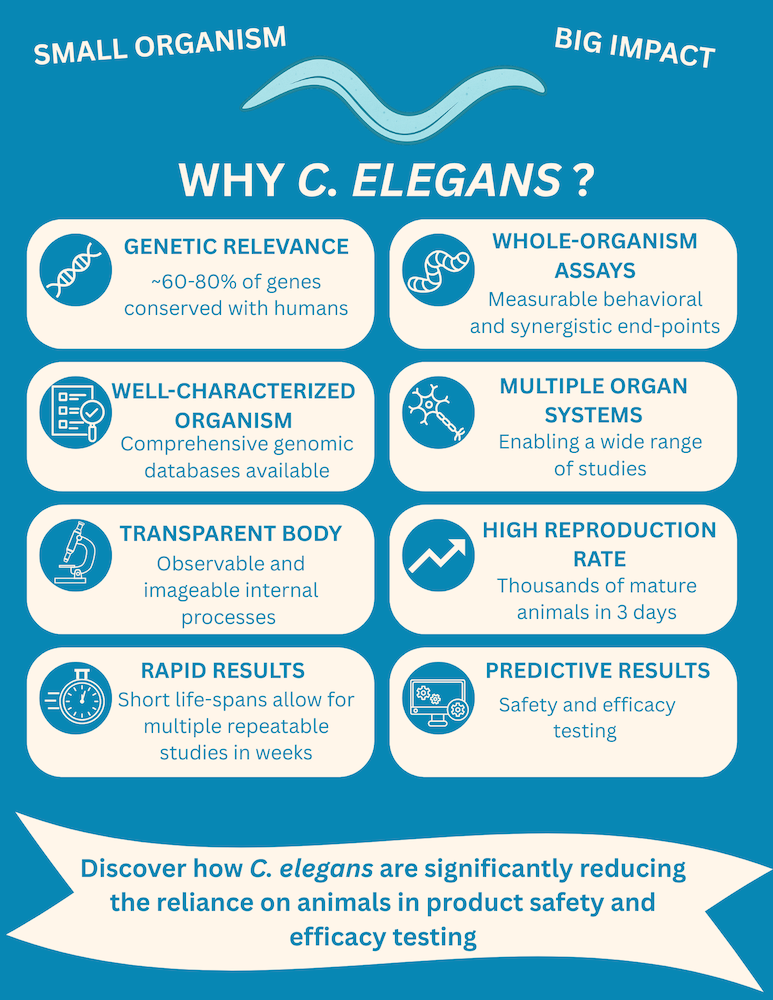
Caenorhabditis elegans (C. elegans), a tiny transparent roundworm, has become one of the most widely used model organisms in scientific research. First introduced to the laboratory by Sydney Brenner in 1965, C. elegans has helped researchers make major discoveries—four of which led to Nobel Prizes. But what makes this worm so valuable, especially when compared to traditional mammalian models?
In this post, explore 8 key reasons why C. elegans are an excellent model organism that can obtain statistically repeatable results faster than ever using vivoVerse’s platform.
1. High Genetic Similarity with Humans and Other Mammals
Although C. elegans are simple invertebrates, they share approximately 60-80% of their genes with humans. Researchers have observed biological responses in C. elegans that mirror those seen in mammals. This high genetic homology allows scientists to study human disease genes and conserved cellular pathways in a simpler, faster model. It’s also a great platform to investigate safe concentrations of food ingredients, environmental compounds, and man-made chemicals.
2. A Well-Characterized Organism
The genetics and development of C. elegans has been extensively studied and characterized. Cells of each hermaphrodite divide in a determinate pattern and maintain predictable functions. This nematode was the first multi-cellular organism to have its entire genome sequenced, and many genes have been identified and their functions elucidated. With decades of research and resources behind it, it’s a go-to model for genetic, developmental, and toxicological studies.
Helpful resource: WormBase – a comprehensive database of genetic information on C. elegans.
3. Whole-Organism Assays Reveal Systemic Effects
Unlike in vitro cell models, C. elegans allows for full-body observations. Researchers can measure behavioral effects, developmental changes, and identify synergistic or off-target effects that might go unnoticed in cell-based models.
4. Small Size, Big Data, Rapid Results
Non-harmful C. elegans are easy to culture and maintain, requiring simple laboratory training and equipment. The minimal space, equipment, and resources needed to conduct experiments make C. elegans accessible for many laboratories. Thanks to their small size, thousands of C. elegans can be maintained in a single benchtop incubator. Experiments can be scaled efficiently using multi-well plates in a cost-effective manner. Our proprietary vivoChip imaging technology combined with AI-assisted large data analysis provides high-content, reproducible results. The low expense of conducting research and toxicology screening with C. elegans can significantly reduce R&D costs in disease modeling and drug discovery, potentially lowering the overall cost of developing human drug therapies.
5. Predictive Results
Studies have shown high concordance with mammalian models in predicting human-relevant toxicology endpoints. The speed and reproducibility of C. elegans assays allow researchers to prioritize chemical libraries for identification of leads with high translational potential. Discoveries made using these assays hold promise for the development of safer chemicals and therapeutics.
6. Fast Life Cycle and High Reproduction Rate
One key practical advantage of C. elegans is its rapid life cycle. The worm progresses from egg to adult in just three days , and a single hermaphrodite can produce roughly 300 offspring within a 90-hour window. This allows researchers to study multiple generations in a short period, accelerating experimental timelines and generating rapid results.
7. Transparent Body = Clear Insights
C. elegans are fully transparent, making it possible to observe internal processes, individual cells, embryos, and fluorescent gene markers. This transparency is crucial for imaging-based experiments and real-time analysis of development, gene expression, and cellular function.
8. Multiple Functional Organ Systems
Even though it’s tiny, C. elegans has these organ systems:
- Nervous system – 302 neurons that are extensively mapped and characterized.
- Reproductive tract – complete with a uterus and sperm in a hermaphrodite worm.
- Digestive system – A pharynx for feeding and an intestine for nutrient digestion.
- Excretory System – System for removing waste.
- Musculature – Muscles required for locomotion.
- Hypodermis and Cuticle – Outer covering to protect internal organs.
This makes C. elegans suitable as a model organism for a wide range of systemic studies such as neurobiology, development, and metabolism.
The Future of Research with C. elegans
With its genetic similarity to humans, ease of use, and cost-effective scalability, C. elegans is a foundational tool in modern science. As a convenient and robust New Approach Methodology (NAMs), it’s helping reduce dependence on mammalian models and speeding up discoveries in human health and disease. vivoVerse offers C. elegans-based assays for product safety and efficacy testing.
Interested in learning more about C. elegans testing? Check out our related posts:
- C. elegans as a Model for Rapid, Cost-Effective Toxicology Assessments
- vivoVerse revolutionizes developmental toxicity testing with AI-assisted high-throughput C. elegans image analysis
References
- Kaletta, T. and M.O. Hengartner, Finding function in novel targets: C. elegans as a model organism. Nat Rev Drug Discov, 2006. 5(5): p. 387-98.
- Hunt, P.R., Building Confidence in the Use of NAMs data for Risk Analysis: C. elegans as a Case Study, J. Camacho, Editor. 2021.
- Corsi AK, Wightman B, Chalfie M. A Transparent window into biology: A primer on Caenorhabditis elegans. In: WormBook: The Online Review of C. elegans Biology [Internet]. Pasadena (CA): WormBook; 2005-2018. Available from: https://www.ncbi.nlm.nih.gov/books/NBK299460/


